
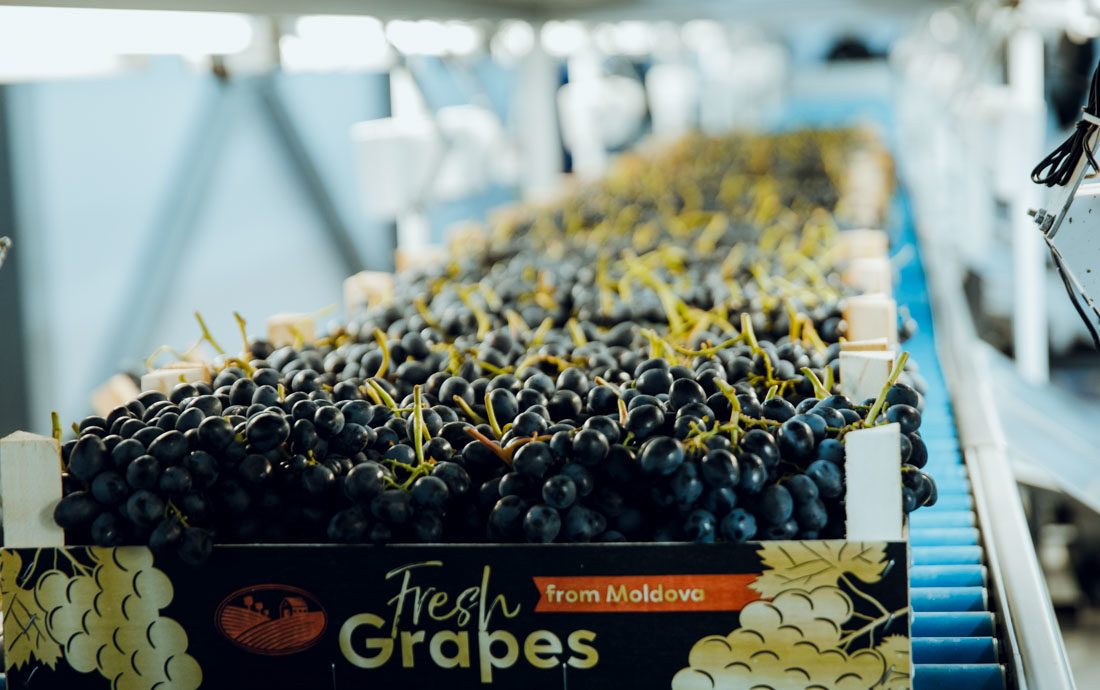
2025 must be viewed with great honesty. It was not an easy year for table grape producers in the Republic of Moldova, and the problems cannot be swept under the rug. October rains put enormous pressure on quality, and many producers did not redirect compromised grapes to processing. This decision—or lack of decision—affected us all: producers, exporters, traders, and even the image of Moldovan products in foreign markets.
1. The October Problem: Grapes That Should Not Have Been Sent for Fresh Consumption
After the rains, a significant portion of Moldova variety grapes were no longer suitable for fresh market sale. However, large quantities still reached the market. What happened?
- In supermarkets, affected grapes generated returns, losses, and blockages
- In wholesale markets, the sudden entry of low-quality batches destabilized prices for everyone, including those who had good product
2. Moldova Variety: Demand Is Declining and the Trend Is Irreversible
Regardless of how attached we are to the Moldova variety, the market reality is clear: demand is declining and will continue to decline. The reason is not about us—it is about Europe. EU countries are massively expanding their range of late-harvest varieties, many of them seedless, with stable commercial appearance and high durability in the logistics chain. Markets want what sells best: crisp, sweet, seedless, calibrated, and uniform grapes.
- Moldova remains a variety appreciated by a certain category of consumers
- But it cannot compete with new European seedless varieties
- Not at large scale, not in the long term
3. What We Must Do as a Sector to Avoid a Downward Spiral
There are several directions that are no longer negotiable:
- a) The state must stop encouraging planting of seeded varieties - Public investments must be oriented toward the future, not toward a model losing market share year after year
- b) Accelerated transition to seedless varieties - This is the only way to remain competitive. Seedless varieties bring: better prices, stable demand, retail access, possibility of contracting before harvest
- c) Development of high value-added processing capacity - In years with EU overproduction, our grapes will have the hardest market access. Processing becomes a safety net
4. What We Learn from 2025
If we want stability, we must accept change. If we want good prices, we must offer a product the market truly demands. If we want respect in European retail, we must be disciplined and professional, including in difficult years.
- 2025 did not punish us. It only showed us where we truly are
- The place where we want to be in 5 years depends on the decisions we make today
Conclusion
The future of Moldovan viticulture depends on our ability to adapt. Every hectare planted with Moldova variety in 2025 is a hectare that will produce losses in 2028–2030. The transition to seedless varieties, development of processing capacities, and collective discipline are not optional—they are survival conditions in the modern European market.
Verifying active substances before application is essential. Learn more about the PesticideUE.md tool for EU regulatory compliance.
Interested in our premium grapes?
Contact us to discuss partnership opportunities.
Contact on WhatsApp