
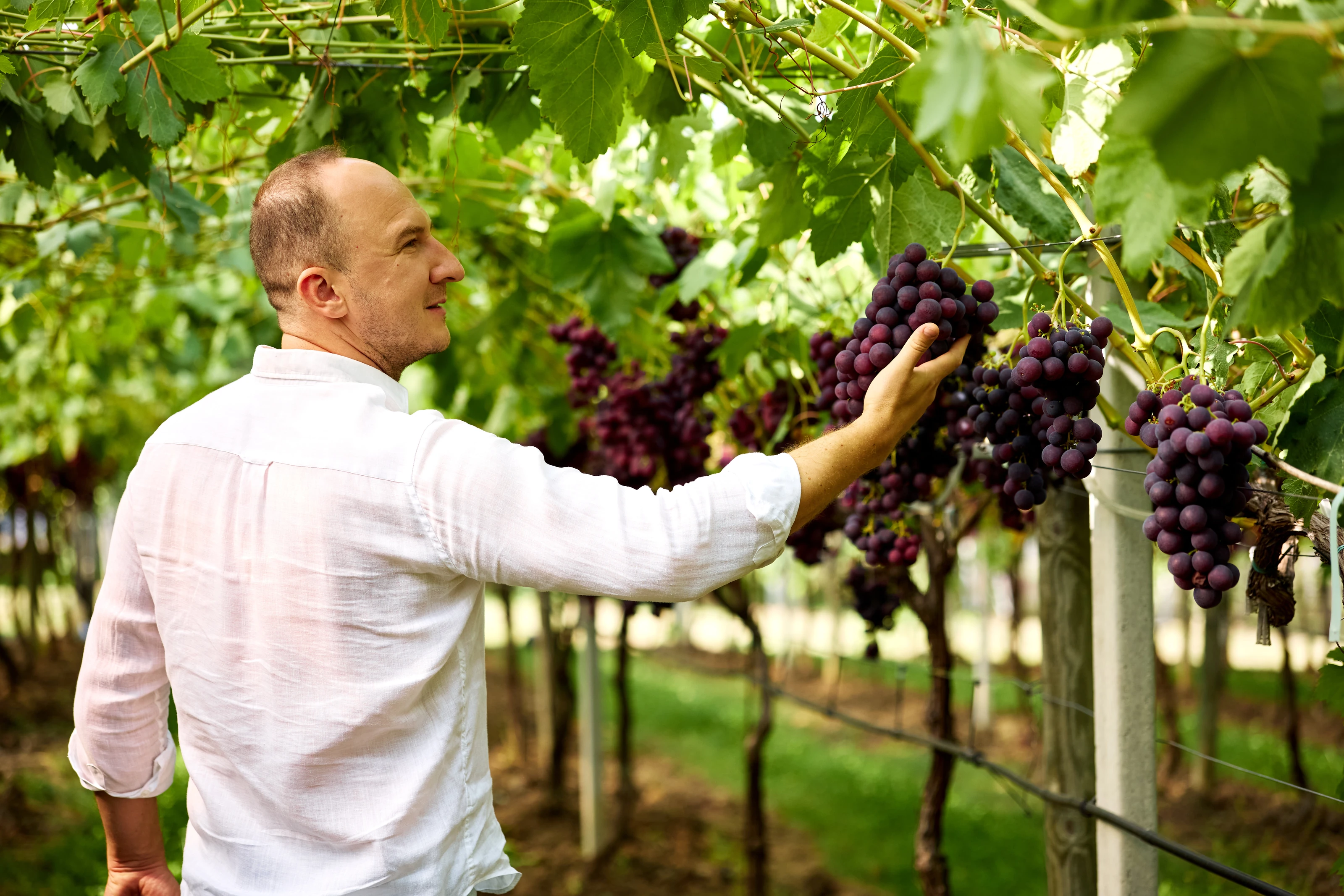
“I never dreamed it could turn out as beautifully as it has.”
For Vlad Vedrașco, the decision to return home from a stable, well-paid job in the United States, a dream for many, “ripened” over time. After seven years abroad, his connection to his family, the land and his childhood memories gradually grew stronger. He began to see Moldova not through the eyes of the frustrated teenager who dreamt of leaving, but through those of an adult lacking a deep connection with the country where he lives and increasingly remembering the value of the place he had come from.
Returning home was not only about reconnecting with his roots. It was also about discovering economic opportunities that he felt were still largely untapped. Table grape production became the field in which he chose to invest his energy, building on his family’s existing business and vineyards.
“I could have chosen any other business, because my intention was clear: to find a field where I could make a difference and go deep into it until we became the best in Moldova and a model for others.”
The first myth he encountered was that Moldovan table grapes were more suited to Eastern markets and would not have much of a chance in Europe. Although this opinion had been circulating among local producers for years, Vlad decided to test his grapes at the wholesale market in Warsaw, where they proved popular with consumers.
“It was a myth created by people who were afraid to change direction.”
In Moldova’s agriculture, the fear of trying new things and the lack of monitoring of plantations’ efficiency have often led businesses to fail, Vlad believes: “Markets change, consumers change, and producers should be able to observe these changes and adapt. This is precisely where the difference begins between having a plantation and building a business.”
That is why his advice to farmers is not to rush into large-scale investments or plant extensive areas. Instead, he recommends starting with a small, carefully designed pilot plantation, equipped with irrigation and protection systems, planted with suitable varieties and developed around a clear understanding of the risks. Once the model proves itself and the numbers make sense, the business can further grow.
“When you spread one drop across six places, nothing really shows. I used to have that tendency too - to do a lot and do it quickly. But it didn’t work. When you try to do everything, you end up doing nothing really well. It is better to do one thing, but do it extremely well. People need to know that you are the one who produces the best plums, or grapes, or raspberries – and that you do it consistently. Not last year, the best, but this year – the worst.”
It is a lesson Vlad wishes he had received at the beginning.
“If someone had given me this advice, I would have shaken their hand and thanked them from the bottom of my heart.”
When he joined the family business, Frudova company, the family already had many plots of land in Costești village, Ialoveni district, but some of the vineyards were inefficient and continued to be worked simply because “it has to be done”. Over time, he understood that work itself is not an indicator of success, because you can work from morning until evening and still fail to build a profitable business.
“We were simply working. In agriculture, you wake up in the morning and start working. And that is a mistake.”
Agriculture, in his view, needs viable models. Producers must be able to see what works, understand why it works and then adapt those solutions to their own businesses.
“Overnight successes take 15 years”
For the Vedrașco family, finding what works has been a journey of roughly 15 years. The first seven were undertaken by the parents, and the following years – together with their children and even grandchildren.
After Vlad and his brother Veaceslav returned from the United States, over approximately eight years, the family transformed their traditional vineyards, which had no irrigation or protection systems and were becoming increasingly vulnerable to a changing climate, into intensive vineyards equipped with modern technologies, sensors and monitoring systems.
This transformation was not achieved overnight. It grew out of years of experimentation, hard work and, above all, the trust and commitment the family had built through both successes and difficult moments.
Each member of the family has found their own role within this shared effort. Vlad’s father is often in the vineyard from as early as 4 a.m., especially during the growing season. His brother, Veaceslav, oversees production, storage and mechanisation, while their mother, Maria, manages the business. Vlad focuses on what comes next - where the grapes will be sold, which partners and markets to pursue, which varieties to develop and which technologies could take the business further.
“I tried to understand what each person is good at and let everyone move in the direction where they are most capable and where things come naturally to them. The combination of our shared passions is what drives the business. I am the one who dreams and flies, while the people around me keep me grounded and take on the hardest part, the execution. Because dreaming is good, having a vision is good, but execution is 99% of any business.”
During harvest, however, the separation of roles gets blurred and everyone gets involved. Someone carries the crates, someone works in the warehouse, another monitors temperatures, while someone else communicates with the partners waiting for the shipment. Even the children take part, although, like most children their age, they would sometimes rather be on their phones or playing Roblox.
“We want them to see the work we do and take part in it, so they understand where everything comes from. I actually hated working in the fields. It was hard work, especially in the heat. But I saw the results, from the hard work in the vineyard all the way to selling the grapes and putting food on the table with the money we earned. There was a real sense of fulfilment and happiness when the grapes were sold and we had the means to keep developing and building. I saw the whole process, and there is a certain adrenaline that comes from seeing your work worth, be it in the heat or rain.”
“If we do not learn to use water and soil efficiently, we risk being left without agriculture”
If there is one issue Vlad believes will shape the future of agriculture in Moldova, it is water — and, inevitably, the health of the soil.
Modern agriculture is becoming increasingly dependent on irrigation, while climate change is making reliable access to water even more critical. At the same time, irrigation water can contain high levels of salts or sodium, and using it without proper analysis and corrective measures can gradually damage the soil, even before the consequences become visible.
The ability to store water is just as important. Moldova can have periods of abundant rainfall, but without the infrastructure to capture and preserve that water, it may not be available when it is most needed.
At Frudova, spring water is seen as a resource to be preserved for the summer, and the company is working on a reservoir system that would allow water to be collected during the wetter months and used during periods of drought.
At the same time, Vlad believes that the planting of new land should be limited, and that we should analyze and understand how efficiently existing land can be utilized, how much water is needed, and how water quality can be improved when it is insufficient.
“I hope we do our homework on time, rather than acting like students who only start 15 minutes before the lesson. No matter how advanced technology becomes, it cannot endlessly compensate for a lack of respect for natural resources or the absence of a strategy for protecting water and soil.”
“In the vineyard, every technological upgrade came as a step forward after a kick in the pants”
Vlad’s fascination with technology goes back to his school years, when he was handed out the keys to the computer room and spent hours playing network games, but also experimenting with building simple websites.
“That is when I understood what a computer could do. From then on, my whole life has been connected to science. A company, just like a person, can grow faster if it has a technological advantage over the rest.”
Many of the technologies now used at Frudova were introduced after difficult experiences. In agriculture, Vlad says, you sometimes have to lose something before you understand what needs to change.
A few years ago, a moth infestation damaged grapes that were already around 90% ripe, resulting in the loss of the harvest. The experience prompted the team to introduce cameras and pest-monitoring systems to detect problems earlier and to reduce the use of insecticides by relying, wherever possible, on traps and pheromones.
For Vlad, technology is about more than efficiency. It is also about responsibility for what ends up on the consumer’s table. He wants the grapes produced by Frudova to be safe enough for his own children to eat. The company is therefore working with a producer of pheromones and traps with the goal of completely eliminating the use of insecticides during the 2026 season.
“I do not want to sell a product that I would be ashamed of, afraid to eat myself, or afraid to give to my children.”
Another painful loss came as a result of heavy rains. In one year, approximately 30–40% of the harvest had to be discarded, and the experience showed that protection against precipitation was no longer a luxury, but a necessity. This is how protective film systems came to be introduced in the vineyards.
Frosts and thermal shocks taught the producers that protection against extreme temperatures also had to become an integrated part of the system. In one difficult year, the same vineyard that could produce approximately 35 tonnes per hectare yielded only 10 tonnes.
Frudova therefore began testing infrared protection technologies, pergola systems inspired by Italy, and automated packaging lines brought from the Netherlands. Each of them had a very clear purpose: to enable the producer to obtain more, more efficiently and with lower risks.
In agriculture, however, even technology cannot completely eliminate unpredictability. A day of extreme temperatures can change the outcome of an entire season, as no one has ever managed to fully tame nature.
“For example, if we have 42 degrees in the sun here in the vineyard and we do not provide sufficient resources for feeding and water, the grapes may begin a reversible process in which the plant starts taking water back from the grapes, causing them to shrivel. And then, of course, you feel like giving up, there is always something unpredictable happening. But we do more than agriculture; every grape is like a child. You care about each one, you forgive what happens and you continue to love it. And we try to reduce unpredictability as much as science allows us to: soil analysis, consistency of the soil structure, temperature and humidity in the vineyards. However, we never forget that nature is nature and life is life.”
Partnership with scientists, more versatile varieties
“We want to develop new varieties because I understand that today it no longer makes sense to plant seeded varieties, that is clear,” says Vlad Vedrașco. In partnership with the National Institute for Applied Research in Agriculture and Veterinary Medicine, he is testing seedless grape varieties.
“We started working this year, the first crosses have been made, embryo extractions are now being carried out, and we are going to have the first offspring… This year we want to have the first tangible results, something to see, so that we can subsequently build on this,” Vlad explains.
Seedless grape varieties are one of the dominant trends on the European market, being preferred by consumers.
“There are still people in science in Moldova, they are at a very advanced age, but we have to try to make use of what we have and let’s help the younger ones grow and learn from them,” says the farmer.
“Bringing 100 farmers together in a cluster is a role worthy of Tom Cruise”
Frudova, as a cooperative or economic cluster, emerged from a simple need: for grape producers to be able to work together and reach markets that would have been much harder to access individually. Members produce the grapes, while the cooperative handles aggregation, sorting, sales and exports, turning the production of several entrepreneurs into a joint offer.
Today, the cluster brings together approximately 15 small producers, with the objective of reaching at least 100 members in the next two to three years.
Since 2026, the Frudova cluster has also become one of the 21 economic clusters supported by UNDP and its partners. It will receive at least $200,000 in non-reimbursable financial support to implement its established strategic objectives and will benefit from technical assistance to promote exports and expand into foreign markets.
The rationale behind clustering in the grape sector is simple: modern exports no longer work according to the model in which a producer harvests a few dozen tonnes and waits for a trader to come and buy them. A large retailer wants the same quality, the same calibre, the same sugar level, the same packaging and the same large quantity, delivered consistently. And for this to be possible, producers in the cluster need to have identical working processes: the same treatment, irrigation, calibration, storage, packaging principles, etc.
In many cases, the challenge is also to shift producers’ mindsets by showing them tangible results: real exports, products on international shelves and concrete figures that demonstrate what they can achieve by working together, beyond what they could accomplish individually. And the Frudova cluster takes on this role: to transform several small producers into a single competitive player on the international table grape market.
“To bring together 100 grape producers, I would have to invite Tom Cruise here too and shoot a ‘Mission Impossible’.
And yet, I believe we will succeed in creating common models that bring everyone more money and more success in the long term. These are always above egos, the desire to be right and the path of a lone hero who manages a farm the way his ancestors did.”
“We cannot live without the vine, and neither can it live without us”
Over time, the team has expanded beyond the family. People responsible for production, exports, packaging and field work have joined, and relationships with them have become part of the company culture.
When asked about his personal life and free time, Vlad smiles and says that work becomes an extension of life and that every professional achievement is just as emotional as any achievement accomplished by a family member.
Technology can automate, systems can scale, but the final result depends on the people who build the business day after day.
“When your child goes to first grade and you are proud of him…, I feel just as proud when a batch of grapes reaches the shelves of a retail chain in Germany and I receive a photo from there. I feel so much dopamine and satisfaction seeing what we have achieved… I am lucky that my family is the core of the Frudova team, and we are also lucky to have all the other people who help us. People are the key to everything one does.”
“When we see the result, we all get emotional. For us, the vine is a member of our family. We cannot live without it, and neither can it live without us,” says Maria Vedrașco, Vlad’s mother.