
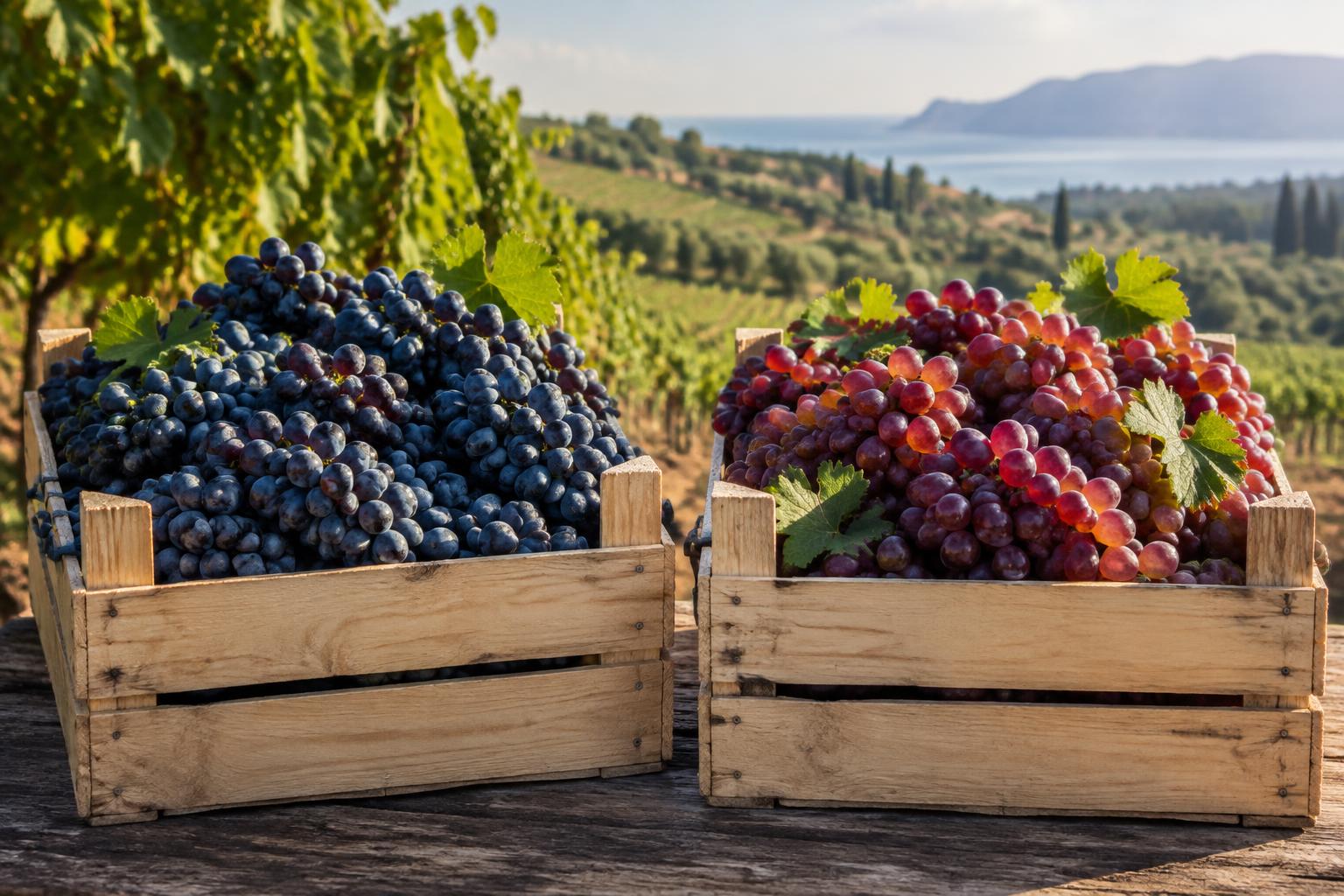
Greece is one of Europe’s earliest table grape origins, strong on seedless white varieties from Corinth and Crete. Moldova sits later in the calendar, closer to Central and Eastern European distribution centres, and specialises in firm, high-Brix fruit with long shelf life. This comparison sets out varieties, calibre, Brix, delivery weeks, certifications and logistics so a category manager can judge both origins on the same criteria.
Side-by-side specification comparison
| Criterion | Moldova (Frudova) | Greece (Corinth / Crete / Kavala) |
|---|---|---|
| Main varieties | Moldova (black), Red Globe, Rosfor, Suruceni | Thompson Seedless / Sultanina, Crimson Seedless, Victoria, Superior |
| Seedless share | Growing, still a minority of volume | Dominant — most export volume is seedless |
| Calibre | 18+ mm, graded per lot | 16–20 mm depending on variety |
| Sugar content | 18+ °Brix | Typically 16–18 °Brix |
| Shelf life | 14–21 days at 0–2 °C | 10–18 days at 0–2 °C, variety dependent |
| Delivery weeks | W32–W45 fresh, cold store to February | W26–W44, early season strength |
| Weekly capacity | Up to 250 t/week at peak | Large, cooperative and exporter based |
| Certification | GlobalG.A.P. (GGN 4063061129826), GRASP, IFS Food | GlobalG.A.P. standard, GRASP and BRC/IFS common |
| Packaging | 4.5 kg and 9 kg cartons, punnets on request | Cartons, punnets, retail-ready packing |
| Transit to Germany | 2–3 days by reefer truck | 3–5 days by reefer truck, ferry or land route |
| Transit to Poland | 1–2 days by reefer truck | 4–5 days by reefer truck |
| Customs status | Third country, EU–Moldova Association Agreement | EU member state, intra-community movement |
| HS code | 0806.10 | 0806.10 |
Moldovan figures are Frudova’s own export specifications. Greek figures are indicative for the main export regions and vary by producer, variety and season.
Delivery calendar by ISO week
| ISO weeks | Moldova (Frudova) | Greece |
|---|---|---|
| W26–W31 | No fresh harvest yet | Early seedless white, peak of the Greek season |
| W32–W36 | Rosfor, first fresh lots — 125–150 t/week | Full programme, seedless white and Crimson |
| W37–W41 | Moldova, Red Globe, Rosfor — peak 250 t/week | Season tapering, late Crimson |
| W42–W45 | Moldova, Suruceni, Rosfor — 175–200 t/week | Largely finished |
| W46–W50 | Cold store — 125–150 t/week | Not available |
| W51–W08 | Winter pack from cold store — 75–100 t/week | Not available |
Where the two origins actually compete
Greece and Moldova overlap only partly, between weeks 32 and 41. Before week 32 Greece has the field to itself with early seedless white fruit; Moldova has no fresh harvest at that point. After week 42 Greek volume is largely finished, while Moldova continues fresh until week 45 and then supplies from cold storage through February.
For a buyer this means the two origins fit together rather than cancel each other out. Greece covers the early and mid summer weeks with seedless volume; Moldova covers the autumn and early winter weeks with firm seeded fruit and long storage life.
Quality: what a buyer can verify on arrival
- Brix: Moldovan fruit is picked at 18 °Brix or above, Greek export fruit typically at 16–18 °Brix
- Firmness: cool continental nights during ripening keep berry skins thick, which is why the Moldova variety travels and stores well
- Shelf life: 14–21 days at 0–2 °C from Moldova, against 10–18 days for most Greek varieties
- Bloom retention: hand harvesting and gentle grading preserve the natural wax layer retail buyers check first
- Residues: every lot is tested against EU Maximum Residue Limits before loading, with a maximum of five detected residues, all below MRL
Compliance and certification
Both origins operate inside EU market rules, but the verification route differs. Greece ships as a member state, so intra-community movement is the default. Moldova exports under the EU–Moldova Association Agreement with a phytosanitary certificate and origin documents per consignment — routine for any experienced importer, but it is paperwork Greece does not need.
- GlobalG.A.P. Integrated Farm Assurance — GGN 4063061129826
- GlobalG.A.P. GRASP for social and labour practice
- IFS Food for packing and handling
- EU MRL compliance verified per lot, with residue reports supplied to the buyer
- Phytosanitary certificate, EUR.1 or origin declaration, CMR and packing list per load
- Full traceability from vineyard block to pallet
Logistics and landed cost
Distance is where Moldova has the clearest structural advantage for Central and Eastern European programmes. Greek fruit reaches Germany or Poland in 3–5 days, often with a ferry leg or a long land route through the Balkans. Moldova reaches the same markets in 1–3 days, which means fewer cold-chain days consumed before the fruit even hits the distribution centre.
- Moldova to Poland: 1–2 days by refrigerated truck
- Moldova to Germany: 2–3 days via Romania and Hungary
- Greece to Germany: 3–5 days by reefer truck
- Greece to Poland: 4–5 days by reefer truck
- Minimum order: one full truck, roughly 20 tonnes
- Temperature: 0–2 °C, relative humidity 90–95 %, pre-cooled within hours of harvest
- Delivery terms: EXW, FCA or DDP depending on the programme
The cost logic, honestly stated
Moldova is usually the lower farm-gate price for comparable seeded quality because land, labour and energy costs are lower, and the shorter haul into Central and Eastern Europe reduces freight. Greece counters with established seedless programmes, retail-ready packing at scale and no third-country documentation — real advantages for a national promotion.
The figure that decides a programme is landed cost per saleable kilogram, not price per kilogram at loading. Longer shelf life and fewer transit days both reduce shrink at store level. We publish specifications rather than prices because grape prices move weekly — ask for a current quote against your exact calibre, packing and delivery week.
When Moldova is the better choice — and when it is not
A clear answer serves a buyer better than a sales pitch.
- Choose Moldova for firm black and red seeded grapes with long shelf life and 18+ °Brix
- Choose Moldova for weeks 42 to 45 and for cold-store supply into February, when Greece is out
- Choose Moldova for short transit into Poland, Romania, Hungary, Germany and the Baltics
- Choose Greece for early-season weeks 26 to 31, which Moldova cannot cover
- Choose Greece when you need continuous seedless white volume or intra-EU movement without third-country documents
Frequently asked questions
Are Moldovan table grapes cheaper than Greek table grapes?
Moldovan farm-gate prices for comparable seeded quality are generally lower, and the shorter haul into Central and Eastern Europe reduces freight cost. Grape prices move weekly, so compare landed cost per saleable kilogram for a specific calibre, packing and delivery week rather than headline price.
When does Moldova supply grapes that Greece cannot?
From calendar week 42 onwards. Greek volume is largely finished by then, while Moldova ships fresh until week 45 and from cold storage through February, at 75 to 150 tonnes per week.
How long is transit from Moldova compared with Greece?
Moldova to Poland is 1 to 2 days and Moldova to Germany 2 to 3 days by refrigerated truck. Greece to Germany is 3 to 5 days and Greece to Poland 4 to 5 days.
What extra paperwork does importing from Moldova require?
Moldova is a third country, so each consignment travels with a phytosanitary certificate and origin documents under the EU–Moldova Association Agreement, alongside CMR and packing list. Greek fruit moves intra-community without those documents.
Which varieties and specifications does Moldova offer?
Moldova (black), Red Globe, Rosfor and Suruceni at 18 mm calibre and above, 18 °Brix and above, 14 to 21 days shelf life at 0 to 2 °C, in 4.5 kg and 9 kg cartons or punnets on request.
Conclusion
Greece owns the early summer weeks and the seedless white category, and no honest comparison says otherwise. Moldova wins on a different set of criteria: 18+ °Brix and firmness in seeded varieties, 14–21 day shelf life, autumn and winter availability when Greece is out of the market, 1–3 day transit into Central and Eastern Europe, and full GlobalG.A.P., GRASP and IFS Food certification. For buyers building an autumn grape programme or a second origin, that combination is worth a trial pallet.
Related reading: Moldova vs Italy table grapes · Table grape technical specifications · AI sourcing advisor
Interested in our premium grapes?
Contact us to discuss partnership opportunities.
Contact on WhatsApp